
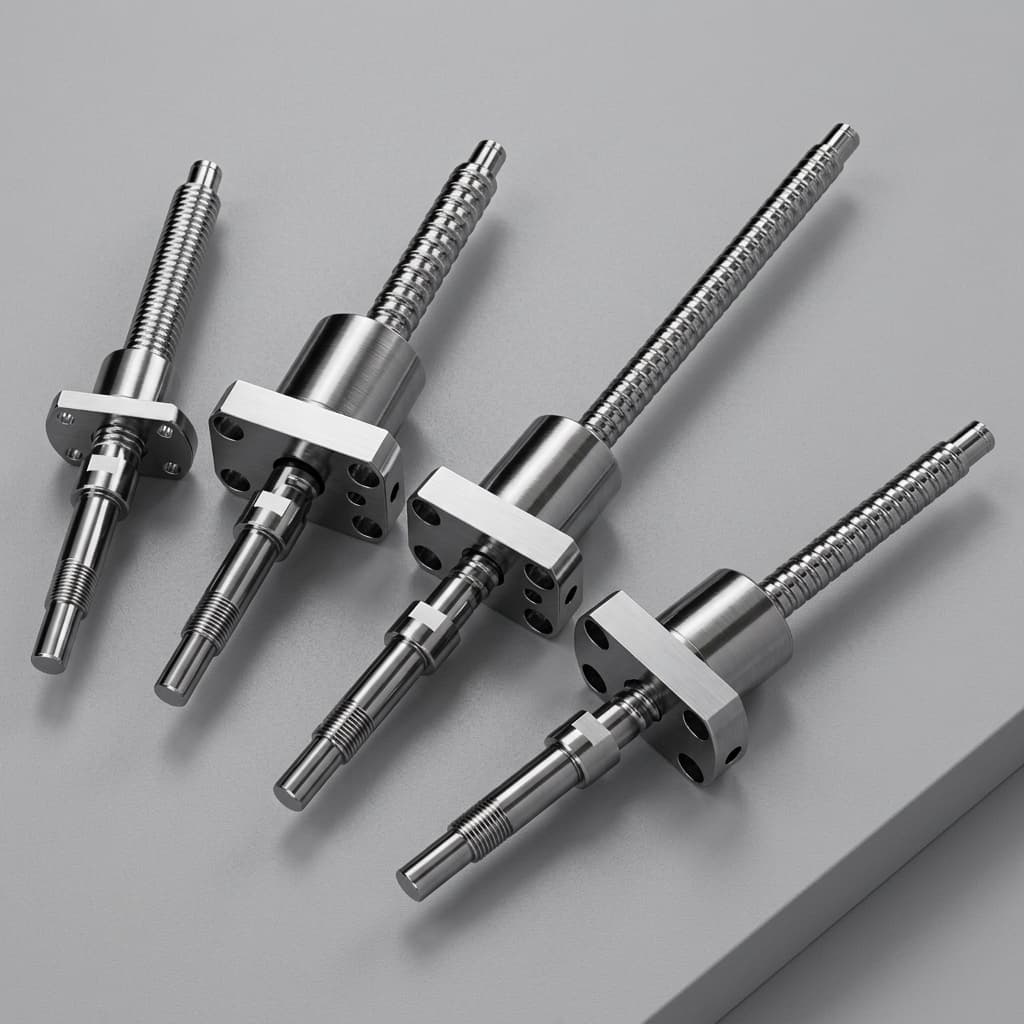
How to Select the Right Inverted Roller Screw for Compact Aerospace Mechanisms
An engineering deep-dive into Inverted Roller Screws (RVi) for flight-control actuators, satellite deployment, and low-backlash aerospace mechanisms.
In aerospace engineering, every gram of weight and every millimeter of space is heavily scrutinized. When designing Electro-Mechanical Actuators (EMAs) for flight surfaces, satellite deployment mechanisms, thrust vector controls, or fin actuators, engineers face a hard packaging and reliability tradeoff in compact envelopes.
For these high-reliability applications, the Inverted Planetary Roller Screw (RVi) is a common architecture to evaluate when hydraulic cylinders or traditional ball screws cannot meet packaging, load, or duty-cycle requirements.
This technical note outlines how to evaluate, specify, and select inverted roller screws for aerospace projects.
What is an Inverted Roller Screw?
In a standard planetary roller screw, the threaded rollers orbit a long central threaded shaft, and the nut assembly travels linearly along the outside.
In an Inverted Roller Screw (RVi), the geometry is flipped inside out. The rollers travel inside a much longer, internally threaded hollow tube (the nut), while the central shaft is relatively short, unthreaded on its outer extremities, and acts as the linear pusher.
Inverted Roller Screw (RVi) Internal Architecture
Why is this better for aerospace EMAs?
- Direct Motor Integration (Hollow Shaft Design): The smooth, cylindrical exterior of the elongated nut allows engineers to mount the motor's rotor magnets directly onto the nut itself. The stator is placed closely around it. This creates a fully integrated actuator that completely eliminates external couplings, gearboxes, or bulky parallel belt drives.
- Drastic Length Reduction: Because the motor and the screw mechanism overlap in the same physical space, the overall length of the actuator can be reduced by up to 40% to 50% compared to a traditional inline configuration.
- Weight Savings: Eliminating couplings, bearing housings, and extra shafts directly translates to mass reduction—a critical KPI for launch costs.
Key Selection Criteria for Aerospace EMAs
When specifying an RVi for flight-grade applications, standard industrial catalogs are insufficient. Consider the following critical parameters:
1. Lead and Pitch Precision
Aerospace mechanisms often require micron-level positioning (e.g., optical array alignments in satellites, or precise fin angle adjustments). Ensure your manufacturing partner can provide precision-ground internal threads on the nut when the program requires tight lead-error control. While thread rolling is cheaper and faster for industrial parts, precision thread grinding is often the better route for minimizing cumulative lead error and achieving controlled axial play, low backlash, and smooth running torque.
2. Lubrication and Vacuum Compatibility
Standard industrial greases outgas in the vacuum of space, contaminating sensitive optics and solidifying in extreme cold.
- For Low Earth Orbit (LEO) or deep space mechanisms, the roller screw must be compatible with dry film lubricants (like MoS2 - Molybdenum Disulfide, or WS2) or specialized vacuum-rated synthetic perfluoropolyether (PFPE) greases (like Braycote 601EF or MAPLUB).
- The geometry of the RVi must be meticulously designed to retain these specialized lubricants without relying on standard elastomeric seals, which may degrade rapidly under cosmic radiation and atomic oxygen.
3. Material Selection and Cryogenic Heat Treatment
Aerospace actuators must survive massive thermal gradients, sometimes shifting from -150°C in shadow to +150°C in direct solar radiation.
- Standard bearing steels (like 100Cr6) are often insufficient due to corrosion risks and brittleness at cryogenic temperatures.
- Premium RVi assemblies for aerospace are typically machined from high-alloy martensitic stainless steels (e.g., 440C, Custom 465, or 17-4 PH).
- To prevent dimensional drifting (where the metal microscopically changes shape over time), the components must undergo strict vacuum heat treatment and deep cryogenic stabilization cycles during manufacturing.
4. Anti-Rotation and Fail-Safe Jam Tolerance
In primary flight control surfaces, a jammed actuator can be catastrophic. Unlike standard ball screws where a shattered ball can physically wedge between the nut and the thread, roller screws exhibit a unique failure mode: they tend to wear down gracefully rather than jamming abruptly. If a single roller fails, the surrounding rollers continue to carry the load, allowing the pilot or flight computer to back-drive or override the mechanism safely. Additionally, RVi designs for aerospace often integrate dual-path anti-rotation splines on the inner output shaft to meet strict DO-160G and MIL-STD-810H redundancy requirements.
Summary
The Inverted Roller Screw is a masterclass in electromechanical integration. By eliminating redundant components and nesting the motor directly over the screw mechanism, aerospace engineers can claw back precious volume and mass without sacrificing an ounce of load capacity, stiffness, or reliability.
Micro Roller Screw supports high-precision miniature and inverted roller screw RFQs. Contact our engineering team to request CAD review, discuss lubrication options, or review your custom EMA project requirements.
Author

Categories
More Posts
Dynamic Load Ratings in Micro Roller Screws: How Procurement Can Avoid Over-Engineering
Use dynamic load ratings in micro roller screws to size L10 life, audit supplier data, and avoid costly over-specification in compact actuator RFQs globally.
Material Cleanliness and Compliance in Micro Roller Screws: A 2026 Procurement Guide
Procurement guide for micro roller screw material cleanliness, ASTM E45 limits, VIM-VAR steel selection, traceability, and 2026 EU compliance watchpoints.
Planetary Roller Screw vs. Ball Screw: Which to Choose for High-Load Actuators?
An engineering and buyer's guide comparing planetary roller screws and ball screws. Includes load capacity data, Hertzian contact mechanics, and TCO analysis.