
Material Cleanliness and Compliance in Micro Roller Screws: A 2026 Procurement Guide
Procurement guide for micro roller screw material cleanliness, ASTM E45 limits, VIM-VAR steel selection, traceability, and 2026 EU compliance watchpoints.
When engineers and procurement teams evaluate micro planetary roller screws for extreme-duty actuators, the discussion typically begins with geometric parameters: pitch, lead, dynamic load capacity, and thread profile. However, as of 2026, the most critical variable dictating both the catastrophic failure rate of the actuator and the regulatory compliance of the supply chain is completely invisible to the naked eye. It is the metallurgical cleanliness of the bearing steel.
In highly demanding applications—such as humanoid robot joints, aerospace electromechanical actuators (EMAs), and medical fluid dispensing pumps—the stresses concentrated on the line contacts of a micro roller screw are immense. A single non-metallic inclusion measuring just a few microns across can act as a stress riser, initiating subsurface micro-cracks that rapidly propagate into catastrophic fatigue spalling.
Concurrently, 2026 industrial-policy proposals and public procurement programs in the EU, US, and other regions are pushing buyers to verify carbon footprint, material origin, and supplier traceability earlier in the sourcing cycle. Procurement managers can no longer evaluate suppliers solely on unit cost and geometric tolerance; they must understand which claims are metallurgical requirements, which are tender requirements, and which are still regulatory watchpoints.
This comprehensive guide serves as a technical bridge between mechanical engineering and strategic sourcing. It details the physics of material cleanliness, how to specify premium vacuum-melted steels, and how to structure your procurement checklists to ensure your micro roller screws deliver uncompromising reliability while meeting modern compliance mandates.
Scope and date: This guide reflects a global sourcing view as of July 20, 2026. It is written for OEM procurement and application engineering teams specifying micro roller screws for high-load actuators. Regulatory notes are planning guidance, not legal advice; verify the final tender language and local law before issuing a binding RFQ.
Fast path for active RFQs: If you are still selecting the screw family, compare roller screw vs. ball screw trade-offs first. For actuator quotation packages, pair this article with the micro roller screw EMA sourcing checklist, then send the load, stroke, duty cycle, and environment for engineering review.
1. The Physics of Fatigue: Why Material Cleanliness Matters
To understand why material cleanliness is non-negotiable for micro roller screws, we must examine the fundamental contact mechanics involved. Unlike ball screws, which rely on the point contact of recirculating spheres, planetary roller screws utilize threaded rollers that orbit the main shaft. This creates a continuous line contact along the flanks of the threads.
While line contact massively increases the load-bearing surface area (allowing for up to 15 times the dynamic load capacity of a comparably sized ball screw), it also subjects a significantly larger volume of subsurface material to extreme alternating shear stresses during every revolution.
Subsurface Fatigue Spalling Initiated by Non-Metallic Inclusions
During the manufacturing of steel, impurities such as oxygen, sulfur, and titanium can react to form microscopic hard particles—known as non-metallic inclusions (primarily aluminum oxides, titanium nitrides, and manganese sulfides).
When a heavily loaded threaded roller passes over the shaft, the Hertzian contact pressure pushes into the subsurface of the steel. If the zone of maximum reversing shear stress happens to coincide with a hard, brittle oxide inclusion, the inclusion refuses to deform with the surrounding steel matrix. This mismatch creates an extreme local stress concentration, tearing the steel matrix and initiating a micro-crack.
Over millions of cycles, this crack propagates toward the surface until a small piece of the thread flank literally flakes off. This is known as fatigue spalling. In high-speed EMAs or robotic joints operating at high frequencies, the initiation of a single spall leads to rapid, cascading failure of the entire actuator, bringing multi-million-dollar production lines or mission-critical hardware to a halt.
The ASTM E45 Standard for Micro-Cleanliness
To mitigate this, engineering teams must specify steel cleanliness according to recognized international standards. The most prevalent standard in North America and globally is ASTM E45 (Standard Test Methods for Determining the Inclusion Content of Steel). Similar standards include ISO 4967 and DIN 50602.
ASTM E45 categorizes inclusions into four types:
- Type A (Sulfides): Highly malleable, elongated during rolling.
- Type B (Aluminates): Hard, brittle, appearing in stringers. Highly detrimental to rolling contact fatigue.
- Type C (Silicates): Brittle and glassy.
- Type D (Globular Oxides): Hard, isolated spherical particles. Very dangerous if located in the high-stress subsurface zone.
Each type is rated on a severity scale from 0.5 (very clean) to 3.0 or higher (dirty), broken down into "Thin" and "Heavy" series based on thickness. For critical micro roller screws, procurement specifications should explicitly mandate bearing-grade steels that meet stringent ASTM E45 limits, typically restricting Type B and Type D inclusions to a maximum severity of 1.0 or lower.
2. Advanced Metallurgy: Air-Melted vs. Vacuum-Melted Steels
To achieve the stringent micro-cleanliness ratings required for extended $L_10$ fatigue life, the method by which the steel is produced is paramount. Procurement teams will generally encounter three tiers of steel processing when sourcing micro roller screws.
Tier 1: Standard Air-Melted Bearing Steel
The vast majority of commercial ball screws and standard-duty roller screws are manufactured from air-melted high-carbon chromium bearing steel, such as 100Cr6 (52100) or 50CrMo4. During the melting process in an electric arc furnace, the molten steel is exposed to atmospheric oxygen and nitrogen. While modern secondary metallurgy (like ladle degassing) significantly improves cleanliness over historical methods, air-melted steel still contains a statistically significant population of oxide and nitride inclusions.
Application Boundary: Suitable for general factory automation, low-duty cycle press machines, and applications where the load is well below 30% of the dynamic load capacity ($C$). It offers the lowest initial cost and the shortest lead times.
Related specification context: material cleanliness does not replace dimensional accuracy. Pair the material callout with lead-error and inspection requirements from our planetary roller screw accuracy class guide.
Tier 2: Vacuum Induction Melted (VIM) Steel
In this process, the steel is melted inside a vacuum chamber. The absence of atmospheric gases prevents the formation of massive oxides and nitrides. Furthermore, the vacuum allows dissolved gases within the melt to outgas, dramatically purifying the alloy.
Tier 3: Vacuum Arc Remelted (VAR) and VIM-VAR Steels
For the absolute pinnacle of metallurgical purity, steel undergoes Vacuum Arc Remelting (VAR). Often, premium aerospace steels undergo a double vacuum process known as VIM-VAR (Vacuum Induction Melted followed by Vacuum Arc Remelted). In the VAR process, a solid ingot is consumed as an electrode in a vacuum chamber, melting drop by drop into a water-cooled copper crucible. This controlled, directional solidification virtually eliminates macroscopic segregation and floats out remaining micro-inclusions.
Application Boundary: VIM-VAR steels (such as premium grades of 440C stainless or Custom 465) are mandatory for mission-critical applications: aerospace flight control surfaces, humanoid robotic joints that must last for 10 years of continuous operation, and implantable or highly critical medical devices.
While specifying VIM-VAR steel can increase raw-material cost substantially, the impact on the dynamic fatigue life of a micro roller screw can justify the premium in severe duty cycles. Cleaner bearing steel generally improves rolling-contact fatigue performance, but the multiplier depends on inclusion population, heat treatment, lubrication film thickness, surface finish, and actual Hertzian stress. Treat claimed 3x or 5x life improvements as supplier-specific claims that require test conditions, load spectra, and inspection evidence.
3. Navigating the 2026 Procurement Landscape: Sustainability and Compliance
Beyond technical specifications, the sourcing landscape for mechanical components is shifting toward low-carbon, traceable, and regionally resilient supply chains. As of July 20, 2026, procurement managers should treat the EU Industrial Accelerator Act as a proposed policy package and compliance watchpoint rather than a fully settled standalone procurement rule. The practical action is still immediate: build traceability, origin evidence, and carbon data into the RFQ before a customer or public tender asks for it.
The Proposed EU Industrial Accelerator Act and "EU Content"
On March 4, 2026, the European Commission announced proposed measures to strengthen EU industry, including an Industrial Accelerator Act and procurement incentives around European, low-carbon, and resilient industrial supply chains. Because final obligations can vary by tender, program, and member-state implementation, buyers should track the approved text and convert customer flow-downs into component-level evidence requirements.
For buyers of micro roller screws integrated into renewable energy systems, railway infrastructure, or defense platforms, the procurement risk is no longer limited to technical nonconformance. A bill of materials may need to demonstrate country of origin, diversified supply, low-carbon material inputs, or customer-specific "EU content" targets. Relying solely on low-cost, air-melted steel from opaque supply chains can weaken an OEM bid even when the screw geometry is correct.
Carbon Footprint Tracking
High-grade steel production is an energy-intensive process. Under emerging procurement frameworks and customer ESG flow-downs, suppliers of precision actuators are increasingly asked to provide lifecycle carbon footprint data for their components.
Vacuum-arc remelting, while metallurgically superior, requires immense amounts of electrical energy. Procurement teams must interrogate the energy mix of their suppliers' steel mills. Specifying VIM-VAR steel produced in regions utilizing high percentages of renewable or nuclear energy can significantly lower the Scope 3 emissions of the final assembled machine, providing a competitive advantage in green procurement evaluations.
4. Material Grade Selection and Comparison
Selecting the right material is a balance of corrosion resistance, fatigue life, load capacity, and budget. The following table provides a structural comparison of the most common materials used in modern micro roller screws.
| Material Grade | Melting Process | Hardness (HRC) | Corrosion Resistance | Relative Fatigue Life | Typical Applications |
|---|---|---|---|---|---|
| 100Cr6 (52100) | Air-Melted / Degassed | 58 - 62 | Low (Requires lubrication/coating) | 1.0x (Baseline) | General Automation, Packaging, Light Press |
| 100Cr6 Premium | VIM or ESR | 58 - 62 | Low | 1.5x - 2.5x | Heavy Duty CNC, Servo Presses, Injection Molding |
| 440C Stainless | Air-Melted | 56 - 60 | High | 0.8x | Washdown Environments, Food Processing |
| 440C Premium | VIM-VAR | 58 - 60 | High | 2.0x - 3.0x | Cleanroom Robotics, Semiconductor, Medical |
| Custom 465 / 455 | VIM-VAR | 50 - 54 | Very High | 3.0x+ (High Toughness) | Aerospace EMAs, Subsea Actuators, Defense |
| Cronidur 30 | PESR | 58 - 60 | Extreme | 4.0x+ | Extreme precision, ultra-high speed applications |
(Note: Relative fatigue life is highly dependent on lubrication, operating temperature, and actual loads. The values above represent general engineering expectations under heavy Hertzian contact stress.)
5. Engineering and Sourcing Checklist for Micro Roller Screws
To bridge the gap between engineering intent and procurement execution, we recommend utilizing the following rigorous checklist when sourcing micro roller screws for high-reliability projects in 2026.
Sourcing & Compliance Audit Checklist
- Material Traceability: Does the supplier provide a certified Mill Test Report (MTR) for the exact heat lot of steel used in the screw shaft and rollers?
- Micro-Cleanliness Certification: Does the MTR explicitly state the ASTM E45 (or ISO 4967) inclusion ratings, and do they meet your engineering maximums (e.g., Type B/D < 1.0)?
- Melting Process Verification: Is the melting process (Air, VIM, ESR, VAR, VIM-VAR) clearly specified and verified on the documentation?
- EU Industrial Accelerator Act Readiness: Can the supplier certify the country of origin for both the raw material and the final machining processes, and can they update documentation when final EU procurement or customer flow-down requirements are issued?
- Carbon Footprint Data: Can the supplier provide an estimate of the embedded carbon (Scope 3 emissions) for the delivered actuator?
- Thread Grinding Metrology: Does the supplier provide coordinate measuring machine (CMM) reports verifying the lead error, pitch diameter, and flank geometry to the required accuracy class (e.g., G1, G3)?
- Heat Treatment Certification: Is there documentation proving the surface hardness (HRC) and case depth (for case-hardened alloys) meet the specification?
- Dynamic Load Verification: If the supplier claims a specific dynamic load capacity ($C$), can they provide the calculation methodology or empirical test data supporting it?
If a supplier cannot answer the material traceability, ASTM E45 rating, melting process, and heat-treatment questions in one documentation pack, treat the offer as unqualified for high-load prototypes until the gap is closed. Contact our engineering team if you want these fields translated into a project-specific RFQ template.
6. Factory Quality Control: The Verification Step
Specifying a premium VIM-VAR steel is useless if the manufacturer cannot verify the integrity of the finished component. High-end micro roller screw manufacturing requires an environment that blends heavy industrial machining with laboratory-grade metrology.
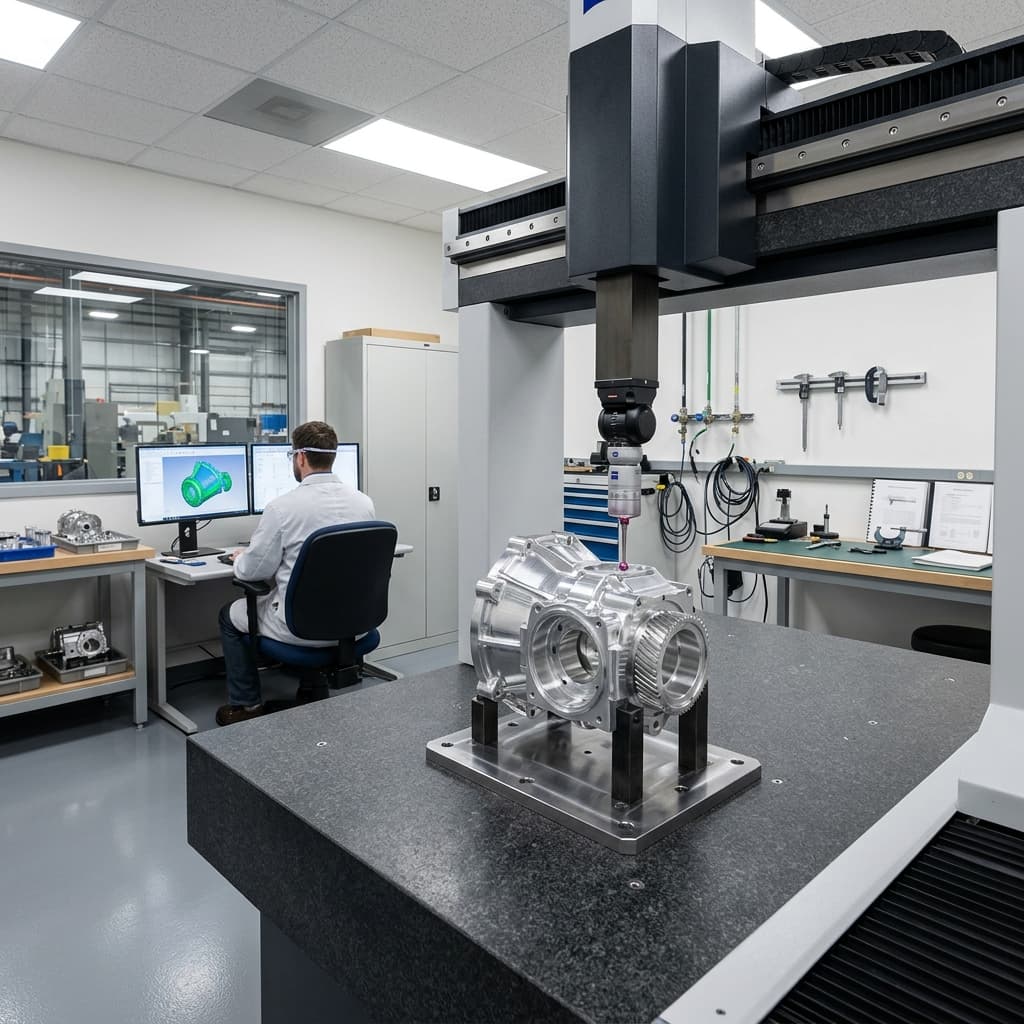 Factory quality control utilizing advanced optical comparators and CMMs to verify the thread flank geometry and surface finish of micro roller screws. Sub-micron surface finish is critical to preventing crack initiation.
Look for suppliers who perform non-destructive testing (NDT), such as magnetic particle inspection or ultrasonic testing, on the finished screws to guarantee that no surface or subsurface defects were introduced during the rigorous thread grinding or heat-treating processes.
7. Frequently Asked Questions (FAQ)
What is the difference between ESR and VAR steel?
Electro-Slag Remelting (ESR) passes the molten steel through a chemically active slag that cleanses it of impurities, particularly sulfur, yielding excellent structural homogeneity. Vacuum Arc Remelting (VAR) melts the steel in a vacuum, which excels at removing dissolved gases (oxygen, nitrogen, hydrogen) and prevents oxidation. For extreme rolling contact fatigue, VIM-VAR is generally considered superior to ESR, though ESR is a massive upgrade over standard air-melted steel.
We currently use ball screws without specifying material cleanliness. Why do we need to care now that we are switching to roller screws?
Ball screws, particularly those sized generously for their application, often fail from wear or recirculation tube jamming long before subsurface fatigue spalling occurs. When engineers upgrade to planetary roller screws, it is almost always to handle massive loads in a highly constrained space. In this regime, you are pushing the physical limits of the steel's Hertzian contact stress limits. At these extremes, subsurface inclusions become the primary failure mode.
Does specifying VIM-VAR steel increase the lead time?
Yes. Premium vacuum-melted steels are not typically stocked in the vast quantities that standard 100Cr6 is. Furthermore, they are often allocated to aerospace and defense contractors months in advance. Specifying VIM-VAR can easily add 8 to 16 weeks to your initial prototype lead times, though strategic suppliers may hold inventory for established production schedules.
How does material hardness affect the load capacity?
The dynamic and static load capacities of a roller screw are directly proportional to the hardness of the contacting surfaces. If the steel hardness drops below 58 HRC, the load capacity calculations must be derated significantly. This is why materials like Custom 465, while incredibly tough and corrosion-resistant, often require specialized surface hardening treatments (like nitriding) to achieve the necessary surface hardness for high-load applications.
Conclusion: Engineering the Supply Chain
The decision to specify micro planetary roller screws represents a commitment to unparalleled mechanical performance. However, ensuring that performance materializes in the real world requires procurement teams to look beyond the blueprint.
By demanding stringent material cleanliness standards like ASTM E45, specifying vacuum-melted alloys for critical applications, and navigating the new realities of 2026 supply chain compliance, you protect your organization from catastrophic actuator failure and regulatory exclusion.
Ready to optimize your next high-performance actuator? Contact our engineering team to discuss material specifications, load requirements, and custom sizing for your micro roller screw applications.
Sources and References
- ASTM International: ASTM E45 - 18a Standard Test Methods for Determining the Inclusion Content of Steel. The global standard for determining and classifying non-metallic inclusions in bearing steels.
- European Commission: Commission proposes new measures to boost EU industry and jobs. Official March 4, 2026 announcement for the proposed Industrial Accelerator Act and related industrial-policy measures.
- SKF Engineering & Research: Pure steel - challenges and measuring methods. Engineering overview of steel cleanliness, inclusion measurement, and why clean steel matters for rolling bearing reliability.
Author

More Posts
How to Select the Right Inverted Roller Screw for Compact Aerospace Mechanisms
An engineering deep-dive into Inverted Roller Screws (RVi) for flight-control actuators, satellite deployment, and low-backlash aerospace mechanisms.
Planetary Roller Screw Accuracy Classes (C3 vs. C5 vs. C7): A Sourcing and Specification Guide
Compare C3, C5, and C7 planetary roller screw accuracy classes, lead error, lead-time risk, cost trade-offs, and RFQ rules for sourcing teams.
The Hidden Costs of Micro Roller Screw Integration: Specifying Custom End Machining
Specify custom end machining for micro planetary roller screws: RFQ tolerances, runout risks, heat-treatment limits, and when to request factory support.