
12mm Miniature Roller Screw
Compare reference leads and estimate torque, life and stability.Request CAD review
Reference benchmarks · Reviewed by Micro Roller Screw.
12mm sizing calculator
Edit inputs for instant estimates. No submission or waiting required.
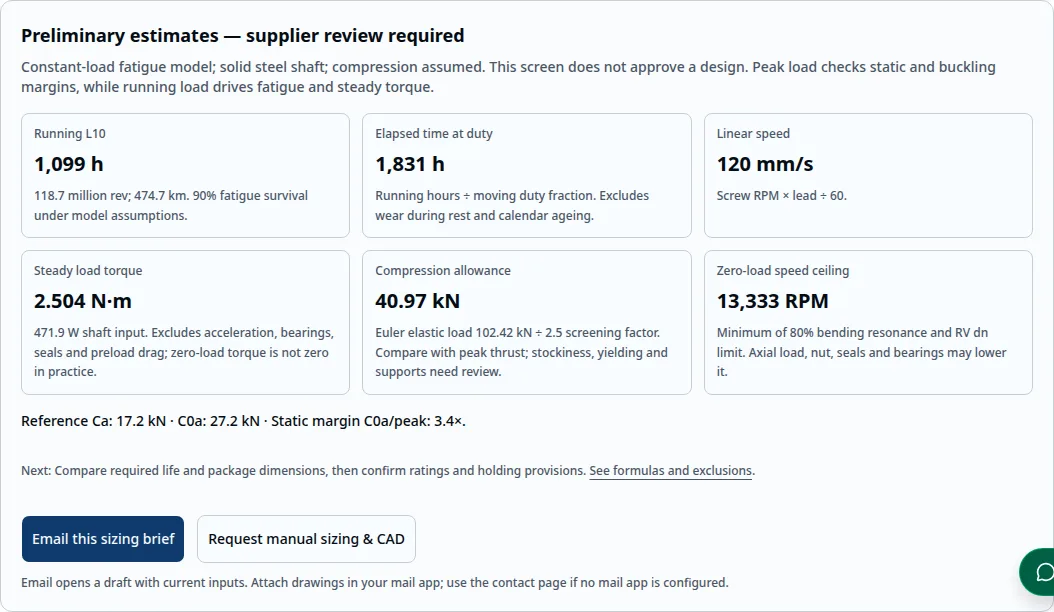
Preliminary estimates — supplier review required
Constant-load fatigue model; solid steel shaft; compression assumed. This screen does not approve a design. Peak load checks static and buckling margins, while running load drives fatigue and steady torque.
- Running L10
- 1,099 h
- 118.7 million rev; 474.7 km. 90% fatigue survival under model assumptions.
- Elapsed time at duty
- 1,831 h
- Running hours ÷ moving duty fraction. Excludes wear during rest and calendar ageing.
- Linear speed
- 120 mm/s
- Screw RPM × lead ÷ 60.
- Steady load torque
- 2.504 N·m
- 471.9 W shaft input. Excludes acceleration, bearings, seals and preload drag; zero-load torque is not zero in practice.
- Compression allowance
- 40.97 kN
- Euler elastic load 102.42 kN ÷ 2.5 screening factor. Compare with peak thrust; stockiness, yielding and supports need review.
- Zero-load speed ceiling
- 13,333 RPM
- Minimum of 80% bending resonance and RV dn limit. Axial load, nut, seals and bearings may lower it.
Reference Ca: 17.2 kN · C0a: 27.2 kN · Static margin C0a/peak: 3.4×.
Next: Compare required life and package dimensions, then confirm ratings and holding provisions. See formulas and exclusions.
Email opens a draft with current inputs. Attach drawings in your mail app; use the contact page if no mail app is configured.
Four decisions before choosing a 12mm screw
Match a complete configuration
Diameter alone cannot establish thrust or fit. Select lead and nut construction together, then approve the envelope.
Reference table and scopeSeparate fatigue from peak loads
Use running duty for life; use peak compression for structural screening. A calculated life does not override a failed limit.
Calculation methodMeasure the support span
Buckling allowance and bending speed both depend on span squared. Doubling span reduces each to one quarter in these ideal models.
Geometry and assumptionsAgree acceptance before procurement
Nominal travel, repeatability, temperature and loaded deflection need separate criteria. A fine lead does not establish system accuracy.
Acceptance evidence12mm reference configurations: know what is being compared
Selected planetary RV benchmarks from Rollvis, printed pp. 24–25, checked 2026-10-31. Values belong to the listed nut construction. They are not a certification of our supplied assembly, and this selection is not the complete available lead range.
| Reference | Ca | C0a | Root d2 | Direct efficiency | Split Ca / C0a |
|---|---|---|---|---|---|
| RV 12 × 1 | 13.6 | 25.0 | 11.89 | 78% | 7.5 / 12.5 |
| RV 12 × 2 | 14.6 | 26.9 | 11.81 | 86% | 8.0 / 13.4 |
| RV 12 × 4 | 17.2 | 27.2 | 11.60 | 89% | 9.5 / 13.6 |
| RV 12 × 5 | 18.1 | 27.3 | 11.49 | 89% | 9.9 / 13.6 |
The 1mm row is planetary RV. Recirculating RVR requires its own data. Split-nut life also requires internal preload loads; single-nut ratings cannot be carried across.
Architecture, stroke and bearing span
Read the maximum free shaft span and the maximum compressed column length from the complete assembly. Check all positions. The calculator uses one span for both preliminary models; if their lengths differ, evaluate each and use the more restrictive outcome. Thread root dimensions follow the selected reference; end journals, hollow shafts and flexible supports require a revised model.
Calculation method, units and limits
The tool is a synchronous, constant-duty screening model. Rollvis handbook, printed pp. 10–15 supplies the fatigue and rotational-speed reference methods. Euler buckling and the chosen structural factors below are explicit engineering screening assumptions.
| Output | Calculation | What it does not establish |
|---|---|---|
| Linear velocity | v = n × p / 60 (mm/s) | Acceleration, reversal dwell or servo tracking. |
| Shaft input torque / power | T = P × p / (2πη × 1000); W = T × 2πn / 60 | Motor sizing: add inertia, bearing/seal friction and preload drag. Efficiency varies with duty. |
| Nominal rolling fatigue | L10 = (Ca/P)³ million rev; hours = L10 × 10⁶ / (60n) | Single nut without preload only. Not total service life or fretting endurance. |
| Elapsed time | Running hours / (moving duty % / 100) | No fatigue benefit in revolutions from rest; no calendar-ageing allowance. |
| Compression screen | FE = fk × π² × E × I / L²; I = πd2⁴/64; E = 206,000 N/mm²; allowance = FE/2.5 | Assumes a solid, straight elastic column. Yielding, short columns and support compliance may govern. |
| Speed screen | ncr = 108 × 10⁶ × 12 × fkr / L²; ceiling = min(0.8ncr, 160,000/12) | Zero axial load model and RV dn upper bound only; loaded shaft, nut and bearing ratings still required. |
| Static margin | C0a / Ppeak; factor below 2 flagged for review | Factor 2 is a preliminary tool criterion, not a universal shock or application approval. |
| Support | fk | fkr | Design question |
|---|---|---|---|
| Fixed–free | 0.25 | 0.40 | Is the unsupported extension checked at full travel? |
| Supported–supported | 1.00 | 1.13 | Can bearings maintain radial alignment under load? |
| Fixed–supported | 2.046 | 1.77 | Is the fixed end sufficiently stiff against rotation? |
| Fixed–fixed | 4.00 | 2.57 | Are both ends constrained as assumed, including temperature effects? |
The calculator flags compression above 20% of the elastic Euler load because loaded resonance needs further analysis; this is an escalation cue, not a stability correction. It withholds fatigue hours at zero RPM and fatigue life at zero running load or with split-nut preload.
Three worked selection scenarios
Illustrative calculations, not customer deployments or test results. Reproduce the first case with Reset defaults; change only the stated inputs for the others.
| Scenario and premise | Process / output | Decision and missing evidence |
|---|---|---|
| Compact actuator: 120mm stroke, 190mm span, fixed–supported | v = 120 mm/s; T ≈ 2.50 N·m; L10 ≈ 1099 running h or 1831 elapsed h. | Compare the life estimate with the project target, then confirm thermal duty, actual ratings and supports. |
| Long extension: span 600mm; retain 120mm stroke | Euler allowance falls to about 4.11 kN; peak is 8 kN. Speed screen also requires loaded-shaft review. | Compression screen fails. Shorten the span, improve support or evaluate a larger shaft. |
| Precision reversal: choose preloaded split nut | Use split Ca = 9.5 kN and C0a = 13.6 kN. L10 is withheld; peak static margin is 1.70. | Obtain preload and both nut-half loads, drag torque and loaded stiffness tests before selecting the motor or life target. |
For a genuinely variable duty cycle, provide force, speed, direction and travel for every phase. Do not substitute arithmetic-average force or intermittent peaks into a constant-load estimate.
Compare alternative drives on the same duty
Engineering comparison framework, not a universal performance ranking. Compare quoted configurations at the same required life, stroke, accuracy, support arrangement and environmental conditions; diameter alone is insufficient.
| Architecture | When to investigate | Tradeoff / evidence to obtain |
|---|---|---|
| 12mm planetary roller screw | Compact loaded duty with a demanding life or stiffness target. | Check nut package, internal drag, lubrication and production cost against the actual requirements. |
| Recirculating roller screw | Fine travel per revolution with configuration-specific ratings. | Confirm return mechanism, available lead and its own speed limit; RV data cannot be reused. |
| Miniature ball screw | A matched ball-screw proposal meets life and package targets. | Compare Ca/C0a, lead, preload, speed and service terms from that exact catalog row. |
| Trapezoidal / lead screw | A supplier can meet the duty with a sliding-thread design. | Verify wear, efficiency, heating and holding behavior experimentally; do not apply the rolling-fatigue model. |
| Larger shaft / alternate layout | 12mm compression or speed screening fails. | Revisit the motor, guides, support span and total envelope before increasing nominal screw size alone. |
Risks, mitigations and stopping conditions
| Risk | Why the tool cannot settle it | Minimum next action |
|---|---|---|
| Power-off motion / backdrive | Lead and efficiency do not prove load holding. | Specify a validated brake or restraint where required; include loss-of-power and fault tests. |
| Fretting during short strokes | Fatigue life excludes lubricant redistribution and oscillatory wear. | Ask for grease compatibility and a representative short-stroke test. Approve any redistribution stroke with machine controls; no universal cycle interval is prescribed. |
| Side loads and alignment | Screw-only axial models exclude bending moments and housing errors. | Use external guides and inspect assembled alignment and loaded torque. |
| Heat and preload | Catalog efficiency is not a thermal map; preload changes internal loading. | Measure temperature, drag torque and running clearance across the actual duty. |
| Qualification mismatch | No clinical, sterilization or aerospace qualification follows from these examples. | Define application-specific materials, traceability and qualification with the responsible engineering team. |
| Cost and schedule | No verified stock, production cost or lead time is provided here. | Obtain a written quote for quantity, inspection, tooling, sample acceptance and delivery. |
Define accuracy and acceptance evidence
ISO 3408-3:2006 addresses ball-screw acceptance conditions and tests. It does not automatically certify a roller screw. Agree any adapted acceptance method and the supplier’s grade definition on the drawing.
| Item | Known on this page | Evidence still needed |
|---|---|---|
| Geometry and ratings | Selected third-party reference rows and root diameters. | Approved supplied drawing, nut envelope, journals and configuration-specific ratings. |
| Lead / travel accuracy | Nominal lead only. | Defined travel-deviation metric, reference length, temperature and inspection record. |
| Backlash and repeatability | Nut construction is selectable; no zero-error guarantee. | Reversal load, test method, measurement resolution, temperature and repeatability report. |
| Axial stiffness | Not calculated. | Loaded deflection of screw, bearings, nut and housing in series. |
| Thermal drift | Not compensated. | Measured temperature distribution and expansion allowance; at assumed α = 11.7 µm/(m·K), a 10 K change gives 117 µm/m. |
| Supply and compliance | Quotation and review required. | Material, heat treatment, traceability, test scope, price and delivery terms. |
12mm roller screw questions
Selecting a configuration
What does 12mm specify?
It describes the nominal screw diameter. It does not specify nut outside diameter, flange, screw root diameter, stroke, accuracy or permissible thrust. Confirm these on the selected drawing.
Does a 1mm lead always require a recirculating RVR screw?
No. The linked RV table includes a 12 × 1 planetary configuration. RVR is a distinct recirculating family; do not mix its ratings or speed limits with RV. This tool uses RV references only.
Is Ca the continuous thrust limit?
No. Ca is an input to a fatigue model. Determine permissible thrust from required life, static margin, buckling, speed, heating, lubrication and the actual load spectrum.
Does a finer lead guarantee sub-micron positioning?
No. Lead changes travel per revolution. Accuracy and repeatability also depend on lead error, encoder, backlash, structural deflection, temperature and control. Agree a measured acceptance criterion.
Understanding the calculator
What does L10 mean?
It is a nominal rolling-fatigue estimate at 90% survival under the model assumptions. It is not a warranty, a maintenance interval or a prediction of short-stroke wear. This tool assumes constant running load and speed.
Why are running hours and elapsed hours different?
Running hours count motion at the entered speed. Elapsed hours divide running hours by the moving-duty fraction. Rest time does not increase fatigue revolutions and can introduce degradation outside this model.
Why enter span separately from stroke?
Stroke is travel; unsupported span is a structural length. Use the maximum free span and compression length from the assembly over the complete stroke. If these differ, check both; no fixed allowance can replace the drawing.
Why is preloaded-nut life withheld?
Preload changes the loads on both nut halves. A life calculation needs that internal load distribution and the actual assembly ratings. The tool uses separate split-nut ratings for screening and does not apply a blanket derating.
Integration and procurement
Will a 1mm lead hold the load when power is removed?
Do not assume self-locking from lead alone. Specify and validate a holding brake or another restraint where backdriving would be hazardous, including fine-lead configurations.
Is a periodic flush stroke always suitable for dithering?
No. Any redistribution motion must fit the available travel, lubrication system and machine operating constraints. Ask the supplier for a short-stroke test plan; the 2.5mm tool flag is only a review cue.
Are these our guaranteed ratings, stock or prices?
No. These are named third-party catalog benchmarks checked on 2026-10-31. Supplied product ratings, material, accuracy, stock, price and lead time must be confirmed in a quotation and approved drawing.
How do I request CAD and a drawing review?
Email the sizing brief from the calculator and attach your assembly envelope, duty spectrum, support layout, life target and quantity. Use the contact page for manual sizing. CAD is selected after configuration review; there is no generic download implied.
Sources, review date and evidence limits
Sources checked on . The 2018 handbook is historical technical reference, not a 2026 product release. Named third-party references support benchmark comparisons; they do not establish affiliation or equivalence with our supplied parts.
First recorded in this repository: . Technical review owner: Micro Roller Screw; review again by April 30, 2027, or when reference data or the model changes.
- Rollvis RV product tables, printed pp. 24–25 (PDF pp. 1–2). Selected RV single/split-nut capacities, root dimensions and reference efficiencies used by the tool. Confirm the current revision for a purchase.
- Rollvis 2018 catalog, printed pp. 10–15 (PDF pp. 12–17). Duty, nominal fatigue life, preload treatment and speed method. Review the original diagrams and definitions before applying the method to a different assembly.
- ISO 3408-3:2006 — official scope and publication record. Ball-screw acceptance context only; no roller-screw certification is claimed.
Public evidence on this page does not establish our load ratings, supplier-specific wear life, shock qualification, sterilization compatibility, customer endurance records, price or delivery. Request the corresponding drawing or test record. Worked scenarios and structural screening factors are explicitly illustrative engineering analysis.
Request a 12mm sizing, drawing and CAD review
Send the assembly envelope, running and peak loads, motion spectrum, support layout, environment, required life, accuracy and quantity. Ask for the actual part drawing, ratings, CAD and quotation. Attach drawings in your mail app; response timing and availability are confirmed during review.
Inquiry Email
Please include screw type, diameter, lead, stroke, load, drawings, STEP files, and quantity timeline.
NDA signing supported prior to drawing uploads.
Instant Chat
WhatsApp Engineering SupportQuick clarification for drawings, sample photos, and lead-time checks. Complete RFQs are usually triaged within one business day.