
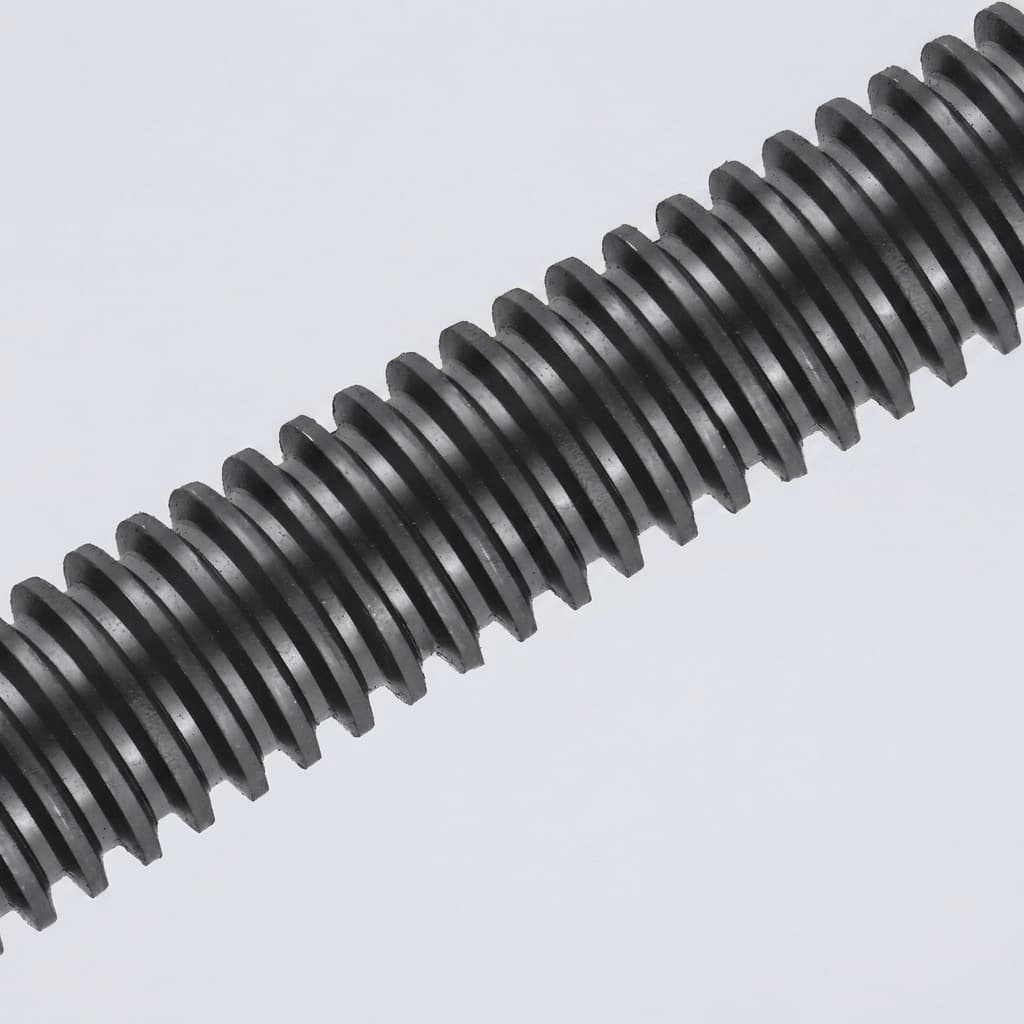
Planetary Roller Screw Accuracy Classes (C3 vs. C5 vs. C7): A Sourcing and Specification Guide
Compare C3, C5, and C7 planetary roller screw accuracy classes, lead error, lead-time risk, cost trade-offs, and RFQ rules for sourcing teams.
One of the most expensive hidden costs in sourcing electromechanical actuators (EMAs) is the over-specification of transmission accuracy. When mechanical engineers transition from hydraulic systems or standard ball screws to high-force planetary roller screws, there is a natural tendency to specify the highest available precision class—typically ISO/DIN Class C3 (or G3)—"just to be safe."
However, in the B2B supply chain of planetary roller screws, "just to be safe" translates directly into doubled procurement costs and lead times that can stretch from 6 weeks to 16 weeks.
Planetary roller screws are inherently premium components designed for extreme load density, shock resistance, and longevity. But not every application requires aerospace-grade sub-micron positioning. Understanding the nuanced differences between accuracy classes—specifically C3, C5, and C7—and how they relate to the manufacturing process (precision thread grinding vs. precision rolling) is critical for procurement teams, distributors, and system engineers looking to optimize Total Cost of Ownership (TCO).
This comprehensive guide breaks down the international standards for lead error, provides clear application boundaries for each accuracy class, and delivers an actionable sourcing framework to prevent over-engineering.
Published: July 18, 2026. Scope: global RFQ and specification guidance for planetary roller screw actuator programs where engineering and procurement teams must choose between C3, C5, and C7 lead accuracy. Limit: treat the tolerance, cost, and lead-time ranges below as RFQ screening bands; final acceptance must be confirmed against the supplier's drawing, inspection report, preload design, nut type, stroke, diameter, lead, material, and end-machining package.
Related specification context: if the project is still comparing screw families, start with roller screw vs. ball screw selection. For EMA sourcing workflow, pair this accuracy-class guide with the micro roller screw RFQ checklist for electromechanical actuators.
1. Demystifying ISO 3408-3 and Lead Error ($e_300$)
When we discuss the "accuracy" of a planetary roller screw, we are primarily talking about lead accuracy (or lead error). This is governed internationally by standards such as ISO 3408-3 (Acceptance conditions and acceptance tests for ball screws), which top-tier roller screw manufacturers like SKF/Ewellix, Moog, and Rollvis adapt for their high-capacity planetary roller screw lines.
What is Lead Error?
Imagine a perfect, theoretical planetary roller screw with a 10mm lead. For every single 360-degree rotation of the nut, it should advance exactly 10.000 mm. In the real world, manufacturing imperfections cause slight deviations. After 30 rotations, the nut should theoretically have traveled 300 mm. In reality, it might have traveled 300.012 mm or 299.988 mm.
This deviation is quantified primarily by the metric $e_300$ (also referred to in some regional standards as $v300p$).
$e_300$ represents the maximum permissible travel deviation (lead error) over any random 300 mm interval of the screw's effective thread length.
Visualizing Lead Error ($e_300$) by Accuracy Class
Note: The actual ISO 3408-3 tolerances differ slightly based on the specific diameter and thread pitch, but the $e_300$ value is the universal baseline used by buyers to compare precision.
2. Breaking Down the Accuracy Classes: C3 vs. C5 vs. C7
The terminology can occasionally vary—some manufacturers use standard ISO classes (Class 1, 3, 5, 7), while others use JIS standards (C0, C1, C3, C5, C7), and some internal naming conventions (like G3 or G5). However, the underlying physical measurements are identical across the industry.
Class C3 (or G3): The Aerospace & High-Precision Standard
- $e_300$ Tolerance: Typically ±8 µm to ±12 µm per 300 mm.
- Manufacturing Method: Multi-pass precision thread grinding. Both the internal threads of the planetary nut and the external threads of the main shaft and rollers are ground to exceptionally tight tolerances in temperature-controlled environments.
- Characteristics: Extremely smooth operation, near-zero backlash (when preloaded), and absolute predictability. The friction torque is highly consistent across the entire stroke.
- The Catch: Because the grinding process is incredibly slow and tool wear must be managed meticulously on hardened high-carbon steel, the lead times for C3 planetary roller screws are consistently the longest in the industry.
Class C5 (or G5): The Industrial Automation Sweet Spot
- $e_300$ Tolerance: Typically ±18 µm to ±23 µm per 300 mm.
- Manufacturing Method: Standard precision thread grinding or high-end precision rolling (depending on the manufacturer and diameter).
- Characteristics: Class C5 represents the "golden ratio" of planetary roller screw specification. It provides high enough precision for 90% of industrial tasks (such as servo presses and automated assembly lines) without the extreme manufacturing bottlenecks associated with C3.
- The Catch: It still requires custom machining for the shaft ends, but the baseline stock of C5 threaded shafts is much more readily available from global distributors.
Class C7 (or G7): Heavy Duty Transport & Fluid Power Replacement
- $e_300$ Tolerance: Typically ±50 µm to ±52 µm per 300 mm.
- Manufacturing Method: Precision thread rolling. Instead of cutting/grinding the threads out of a solid hardened bar, the threads are cold-formed by rolling dies under immense pressure.
- Characteristics: Rolling produces a thread with excellent surface finish and actually work-hardens the surface, resulting in superb fatigue life and load capacity. It is significantly cheaper and faster to produce than grinding.
- The Catch: The rolling process inherently introduces microscopic variations in lead pitch. C7 screws are not suitable for CNC machine tool axes where open-loop absolute positioning is required.
3. The Sourcing Impact: Cost, Lead Time, and System Architecture
Procurement teams must recognize that moving from C7 to C3 does not simply increase the price by 10%; it fundamentally changes the supply chain dynamics. Thread grinding is a severe bottleneck in the global machine tool supply chain.
The following matrix illustrates the commercial and technical trade-offs for OEM buyers:
| Accuracy Class | $e_300$ Tolerance | Primary Manufacturing Method | Relative Cost Multiplier | Typical Lead Time (Custom) | Primary Application Profiles | Backlash & Preload Suitability |
|---|---|---|---|---|---|---|
| C0 / G0 | ±3 - 5 µm | Lapped Grinding | 5.0x+ | 20+ Weeks | Semiconductor lithography, ultra-vacuum test chambers. | Perfect. Zero backlash, constant torque. |
| C1 / G1 | ±6 µm | Precision Grinding | 4.0x | 16 - 20 Weeks | Sub-micron optical stages, precision CNC coordinate machines. | Excellent. |
| C3 / G3 | ±8 - 12 µm | Precision Grinding | 2.5x - 3.5x | 12 - 18 Weeks | Aerospace flight controls, ultra-precision medical imaging, optical alignment. | Excellent. Allows for heavy preload without torque ripple. |
| C5 / G5 | ±18 - 23 µm | Grinding / High-end Rolling | 1.5x - 2.0x | 8 - 12 Weeks | Servo presses, injection molding, automated welding guns, robotics. | Very Good. Standard industrial preload applies. |
| C7 / G7 | ±50 - 52 µm | Precision Cold Rolling | 1.0x (Baseline) | 4 - 8 Weeks | Hydraulic cylinder replacement, heavy AGV lifts, timber processing, packaging. | Moderate. Best suited for single-nut designs with minimal preload. |
| C10 / G10 | ±210 µm | Cold Rolling | 0.8x | 2 - 4 Weeks | Non-precision lifting, manual adjustments, large structural jacks. | Poor. Not intended for preloading. |
(Note: Relative cost multipliers and lead-time ranges are indicative RFQ planning bands for July 2026 global sourcing discussions, not supplier commitments. Confirm the final accuracy class, inspection method, and lead-error report with each manufacturer for the specific diameter, lead, stroke, nut type, preload, material, and end-machining package.)
The "Linear Encoder" Loophole
Here is a critical engineering secret that procurement can use to save hundreds of thousands of dollars on a high-volume EMA program: You do not always need a C3 screw for C3 positioning.
If the system architecture relies on the motor's rotary encoder to calculate linear position (an open-loop linear system), then the screw's lead error directly becomes the system's positioning error. In this case, a C3 screw might be mandatory.
However, if the system utilizes a secondary absolute linear encoder (like a glass scale or magnetic tape) mounted parallel to the actuator, the control system forms a closed-loop. The linear encoder provides the absolute position, and the servo drive simply commands the motor to turn until the encoder reads the correct position.
In a closed-loop system, the lead error of the screw becomes largely irrelevant. You can specify a significantly cheaper, faster-to-source C7 rolled planetary roller screw and still achieve sub-micron positioning accuracy, because the linear encoder handles the precision, while the roller screw purely acts as the high-force "muscle."
Thermal Expansion vs. Lead Error
Furthermore, specifying a C3 screw is often a waste of money if the actuator operates in a high-temperature environment. A 1000mm steel screw will expand by roughly 11 µm for every 1°C increase in temperature. If your heavy-duty actuator heats up by 20°C during operation, the thermal expansion (220 µm) massively dwarfs the $e_300$ lead error difference between C3 (12 µm) and C7 (50 µm).
4. Application Boundaries: When to Spec Which Class
To prevent over-engineering, use these strict application boundaries during the DFM (Design for Manufacturing) phase.
Mandatory C3 Use Cases:
- The actuator must hit absolute positioning targets relying solely on the motor's rotary encoder.
- The application requires a heavily preloaded double-nut design to eliminate 100% of backlash. (Using a heavily preloaded nut on a C7 screw can cause the nut to bind on the areas where the thread pitch slightly fluctuates).
- The friction torque must remain perfectly constant across the entire stroke (e.g., in delicate force-feedback haptic devices).
Mandatory C5 Use Cases:
- General automation where positional repeatability is required without external linear scales.
- High-speed continuous duty cycles where the smoother ground surface finish of C5 generates marginally less internal heat than C7.
- Standard robotic joint actuation.
Mandatory C7 Use Cases:
- Replacing fluid power (hydraulic or pneumatic cylinders) where the primary goal is raw pushing/pulling force, not micrometer-level positioning.
- Scissor lifts, heavy press brakes, and automated guided vehicle (AGV) suspension/lift mechanisms.
- Any system that already utilizes a closed-loop linear encoder.
5. Procurement Checklist for Roller Screw Accuracy Specification
Before sending out an RFQ for a custom planetary roller screw, procurement and engineering teams should jointly review this checklist to ensure the accuracy class is justified:
- Verify the Control Loop: Is the system using an external absolute linear encoder? If yes, challenge the need for C3/C5; request a quote for C7.
- Analyze Thermal Conditions: What is the expected steady-state operating temperature? If $\Delta T > 10^\circ C$, thermal expansion will likely exceed the lead error. Focus on thermal compensation in software rather than buying tighter hardware tolerances.
- Differentiate Repeatability vs. Accuracy: Does the application need to hit a specific mathematical point in space (Accuracy), or just return to the exact same position over and over (Repeatability)? C7 screws have lower accuracy but often excellent repeatability.
- Check Preload Requirements: If engineering specifies a heavily preloaded split-nut to eliminate backlash, verify that the manufacturer guarantees smooth friction torque. C3 or C5 is usually required for heavy preloads to prevent binding.
- Request Lead Time Alternatives: Always ask the supplier to quote the requested accuracy class (e.g., C3) alongside the next step down (e.g., C5) to visualize the cost and lead time delta.
6. Frequently Asked Questions (FAQ)
Does a C3 planetary roller screw have a higher load capacity than a C7?
No. In fact, a precision-rolled C7 planetary roller screw can sometimes exhibit a slightly higher dynamic load capacity and fatigue life than a ground C3 screw of the same size. The cold-rolling process work-hardens the surface and creates favorable compressive residual stresses in the thread roots, whereas grinding cuts through the grain structure.
If C7 is cheaper and stronger, why do manufacturers push C3 and C5?
Planetary roller screws are inherently difficult to manufacture. The intricate internally threaded nut must be machined and ground; it cannot be rolled. Mating a ground precision nut to a rolled C7 shaft requires deep engineering expertise to manage the tolerance stack-up and ensure smooth orbital rolling of the planetary rollers. Many suppliers simply prefer the predictability of grinding all components (C3/C5) rather than managing mixed manufacturing methods.
How does accuracy class affect backlash?
Accuracy class (lead error) and backlash are related but distinct concepts. Lead error is the deviation in travel distance. Backlash is the axial "play" or lost motion when reversing direction. You can have a highly accurate C3 screw with high backlash, or a C7 screw with zero backlash (if preloaded). However, tighter accuracy classes (C3) allow for tighter, more consistent preloading without creating binding spots along the shaft.
Can a worn C3 screw be refurbished?
Yes. Top-tier manufacturers can often refurbish high-end C3 and C5 planetary roller screws by re-grinding the shaft threads (oversizing them slightly) and manufacturing a new set of customized rollers to match the new pitch diameter. This is usually only economical for large diameter screws (>40mm) used in expensive heavy industry presses.
7. Conclusion: Optimize the Spec, Protect the Supply Chain
Sourcing planetary roller screws requires a delicate balance between mechanical necessity and supply chain reality. Over-specifying to ISO C3 when a C5 or C7 would suffice not only drains the BOM budget but introduces unnecessary supply chain fragility due to the limited global capacity for precision thread grinding.
By deeply understanding the relationship between lead error ($e_300$), closed-loop control architectures, and manufacturing methods, procurement teams can confidently downgrade accuracy specifications while maintaining or even improving the system's overall performance and longevity.
Are you finalizing the BOM for an upcoming Electromechanical Actuator (EMA) project? Contact our engineering team for a comprehensive design review. We will help you select the optimal accuracy class, preload, and lubrication strategy to minimize lead times and maximize continuous-duty lifespan.
Sources & References
- ISO 3408-3:2006 - Ball screws — Part 3: Acceptance conditions and acceptance tests. International Organization for Standardization. Retrieved from iso.org. (The foundational standard applied across the industry for defining $e_300$ and $v300p$-style lead-deviation acceptance tests).
- Moog Inc. - Planetary Roller Screws. Retrieved from moog.com. (Manufacturer reference for planetary roller screw product ranges and ISO 3408-3 precision classes).
- Moog Inc. - Planetary Roller Screws Catalog. Retrieved from moog.com PDF. (Manufacturer application and performance context for planetary roller screws in high-duty electromechanical actuation).
- Ewellix - High Performance Actuator for Heavy Duty Applications. Retrieved from ewellix.com PDF. (Manufacturer context for EMA power density, continuous-duty use, and fluid-power replacement applications).
Author

More Posts
Material Cleanliness and Compliance in Micro Roller Screws: A 2026 Procurement Guide
Procurement guide for micro roller screw material cleanliness, ASTM E45 limits, VIM-VAR steel selection, traceability, and 2026 EU compliance watchpoints.
How to Select the Right Inverted Roller Screw for Compact Aerospace Mechanisms
An engineering deep-dive into Inverted Roller Screws (RVi) for flight-control actuators, satellite deployment, and low-backlash aerospace mechanisms.
Planetary Roller Screw vs. Ball Screw: Which to Choose for High-Load Actuators?
An engineering and buyer's guide comparing planetary roller screws and ball screws. Includes load capacity data, Hertzian contact mechanics, and TCO analysis.