
Short-Stroke Dithering and Fretting Wear in Micro Roller Screws: Preventing False Brinelling, Starvation, and Lost Motion in Precision EMAs
Assess short-stroke dithering in micro roller screws: fretting risks, lubricant and preload trade-offs, qualification tests, and RFQ checks. Request review.
Short-stroke dithering in micro roller screws requires a wear qualification alongside conventional load and fatigue sizing. Repeated small reversals can leave the same contact region poorly replenished with lubricant. False brinelling, friction changes, and increased lost motion are possible consequences; a catalog dynamic load rating does not establish resistance to this duty.
For mechanical designers, controls engineers, and OEM sourcing teams, the buying decision is whether a specific screw, preload, lubricant, and motion profile meets the actuator's end-of-test accuracy and torque limits. This guide provides a diagnostic matrix, a qualification method, and an RFQ checklist for that decision.
Published and reviewed October 29, 2026. Scope: Global engineering screening for miniature planetary roller screws with nominal shaft diameters of 1.5–10 mm in precision electromechanical actuators (EMAs). The procedures below are proposed engineering checks, not reported factory tests or guaranteed product performance. Bearing literature supports the wear mechanisms by analogy; it does not validate a miniature screw design. There is no universal safe stroke-to-lead ratio, sweep interval, grease grade, or preload percentage established by the sources cited here. Medical, aerospace, vacuum, and other regulated applications require their own qualification.
Start with our dynamic load rating guide, accuracy grade tolerances, and preload and drag torque trade-offs. For a duty-profile review, submit an engineering inquiry.
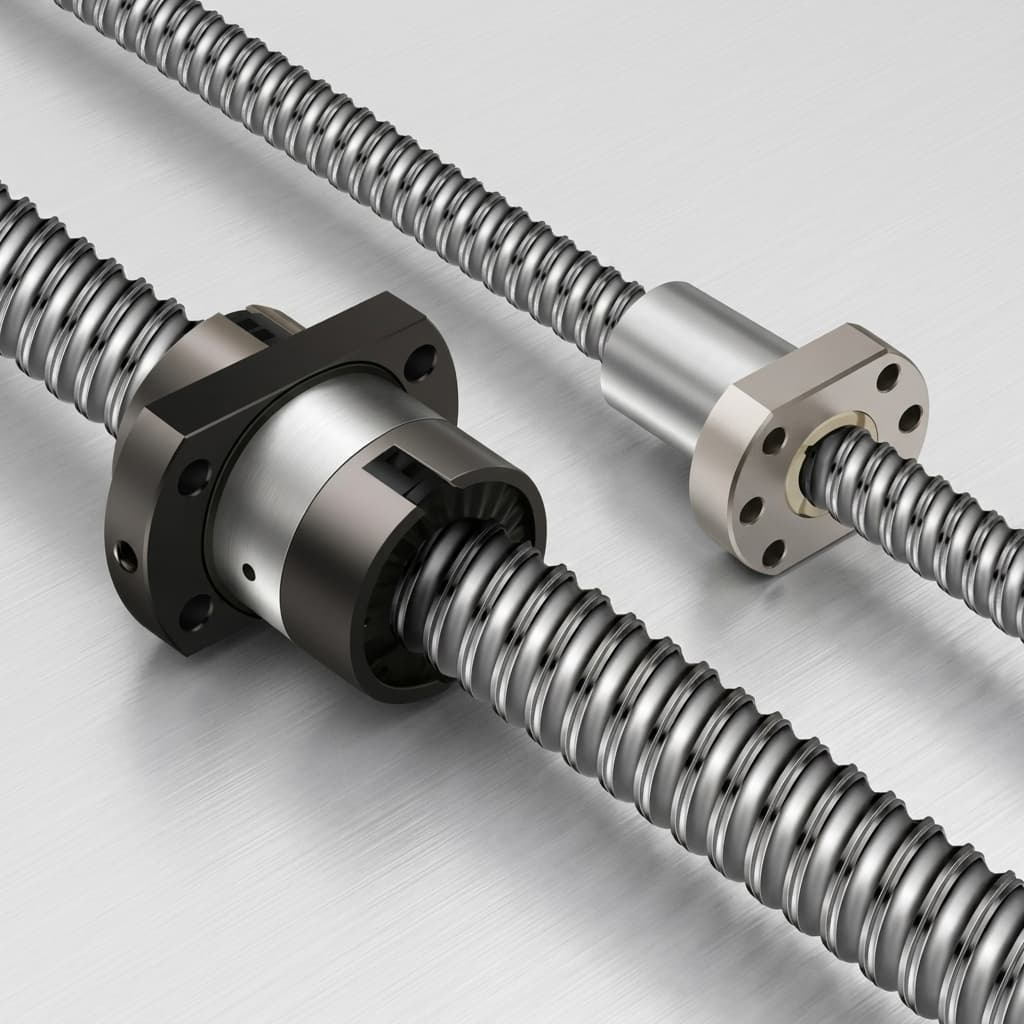
The cover image illustrates a screw assembly; it is not a wear micrograph or evidence of a dither endurance test.
1. Why Short-Stroke Dithering Can Starve a Contact
Planetary roller screws distribute axial load through multiple threaded rolling elements. Rollvis's product overview identifies planetary and other roller-screw architectures; its homepage does not prescribe a micro-dither operating limit.
Repeated reversals, dwell, and low entrainment speed can make local lubricant replenishment difficult. However, stroke length alone does not determine whether an elastohydrodynamic (EHL), mixed, or boundary lubrication condition exists. Contact geometry, viscosity at operating temperature, surface roughness, lubricant supply, speed, and load all matter. Every reversal also passes through zero speed, even during a long stroke.
Define the motion before comparing supplier proposals:
- Peak-to-peak stroke, Spp: the complete travel between reversal endpoints. A command of ±0.05 mm has Spp = 0.10 mm.
- Lead, Ph: axial travel per screw revolution. Spp / Ph expresses screw rotation over that excursion, not a planetary roller's rotation or guaranteed contact renewal.
- Frequency, f: complete back-and-forth cycles per second. State dwell and the waveform separately.
- Duty and load: percentage of operating time spent dithering, axial load direction, preload, temperature, and vibration during powered or unpowered holding.
Worked screening example, not test data: with Ph = 1 mm, ±0.05 mm motion at 20 Hz gives Spp / Ph = 0.10, a screw excursion of 0.10 revolution between endpoints, and 72,000 full oscillations per hour. These calculations describe exposure only. They do not predict film thickness, roller motion, or service life.
2. False Brinelling, Fretting, and Lost Motion
SKF's explanation of ISO 15243 associates false brinelling with small oscillatory motion or vibration at rolling contacts. It distinguishes this from fretting corrosion at mating fits and from overload deformation. This bearing terminology is useful for inspecting screw assemblies, but transferring a diagnosis requires examination of the actual damaged surfaces.
Conceptual Contact Conditions: Lubricant Supply and Local Wear
Conceptual schematic, not to scale. Neither panel establishes measured film thickness or a guaranteed wear outcome.
Repeated local slip can disrupt surface protection. Wear debris, oxidation, and lubricant condition may then contribute to further damage. A reddish mark alone cannot establish the mechanism; similar symptoms can have different causes. Photograph the tracks and retain lubricant samples before cleaning a returned assembly.
Local wear can increase lost motion around the dither position or change breakaway torque. Measure motion at the actuator output: a motor encoder can show commanded rotation while backlash, coupling compliance, or support-bearing movement absorbs part of the output displacement. Increasing servo gain cannot restore removed material.
3. Failure Mode Matrix for Engineering and Supplier Reviews
Use the seven checks below as an inspection plan, not a diagnosis from appearance alone. They adapt the distinctions in the SKF reference to questions about the complete EMA.
| Inspection check | Overload indentation hypothesis | False-brinelling / local wear hypothesis | Rolling-contact fatigue hypothesis |
|---|---|---|---|
| Event history | Review crashes, assembly forces, and transport shocks | Review dither, dwell, and holding vibration | Review accumulated load and travel |
| Track location | Map dents against a suspected overload event | Compare marks with the repeated operating zone | Map pits over the loaded travel region |
| Surface examination | Check for displacement and permanent indentation | Check for worn finish and shallow depressions | Check for cracks, flaking, and spalls |
| Lubricant sample | Retain for contamination and mixed damage checks | Compare debris and oil condition with a fresh sample | Retain particles for material analysis |
| Output measurement | Compare before and after the event if records exist | Compare reversal response inside and outside the dither zone | Check accuracy across the full operating stroke |
| Torque measurement | Record location-specific resistance | Record breakaway and running torque in both directions | Correlate torque with rough running and inspection findings |
| Corrective-action trial | Review load path, stops, and assembly process | Compare lubricant, preload, and an approved motion change | Review supplier sizing assumptions and contamination control |
Multiple mechanisms can coexist. Inspect guidance, alignment, supports, seals, and couplings before assigning all lost motion to the screw threads.
4. Qualifying a Sweeping Stroke or Wiping Cycle
A longer redistribution stroke is a candidate mitigation when the machine can safely leave its working position. It may move lubricant across a larger region, but it does not reverse existing wear or guarantee film recovery.
Conceptual Motion Sequence: Dither and an Approved Redistribution Sweep
Conceptual trajectory only. Sweep distance and interval must be established for the assembly and application.
Define the Motion Permission Before the Interval
Ask the supplier to propose a sweep envelope using the actual roller kinematics, loaded thread length, lubrication access, available travel, and acceleration limits. A rule such as “three times the lead” or “1.2 times the nut length” is not a universally validated replenishment criterion. Confirm collision clearance, process interruption, stopping distance, and return accuracy before enabling the motion.
Proposed Qualification Method
- Freeze the configuration: record screw and nut drawings, preload or clearance, lubricant product and fill quantity, seals, alignment, temperature, and sensor locations.
- Record the baseline: measure output reversal error, breakaway and running torque, and housing temperature under defined load and thermal conditions.
- Compare duty profiles: test the required dither profile and, when permitted, the same profile with a candidate sweep. Use comparable assemblies, document sample count, and retain a baseline condition.
- Inspect at planned intervals: log cycles, elapsed time, torque, temperature, and output error. Agree stop limits before testing rather than continuing until seizure.
- Inspect the hardware: document track condition and lubricant debris. Recheck accuracy after a defined cool-down under the same measurement procedure.
- Approve the operating envelope: record the tested sweep distance and interval, loads, temperatures, sample results, and limitations. Requalify relevant changes to lubricant, coating, preload, or firmware.
A useful purchase acceptance statement is: “After N agreed cycles, output lost-motion growth shall remain below X µm, with breakaway torque below Y at the specified load and temperature.” Fill N, X, and Y from system requirements and a feasible measurement method; they are not catalog defaults.
5. Lubricants and Coatings: What Evidence to Request
Grease consistency and base-oil viscosity are different properties. NLGI grade alone cannot establish replenishment, friction, or wear protection. A softer grease may redistribute more readily yet leak from the intended housing; a lower-viscosity oil may reduce drag yet provide inadequate separation under load.
The six options below are qualification candidates, not a performance ranking. No cycle-life multiplier, friction reduction, cleanliness rating, or delivery premium is implied.
| Candidate strategy | Selection question | Evidence needed | Limitation to resolve |
|---|---|---|---|
| Existing qualified grease | Does it tolerate the new dither duty? | Assembly endurance, torque, and inspection records | Rotary-duty approval may not cover oscillation |
| Softer anti-fretting grease | Does replenishment improve without leakage? | Named formulation, compatibility, fill method, and leakage test | NLGI 0 or 00 is not automatically suitable |
| Different base-oil viscosity | Is film supply adequate across temperature? | Viscosity-temperature data and loaded torque/wear testing | Lower drag does not prove better wear resistance |
| Metered oil supply | Can the machine supply and contain oil? | Feed-path, flow, seal, and contamination-control validation | Added plumbing; starvation can still occur |
| DLC or another thin coating | Can the coating survive loaded thread contact? | Thickness, adhesion, finish, dimensional, and endurance records | Cracking, delamination, and altered clearance remain risks |
| Bonded solid lubricant | Is replenishment unavailable or fluid use restricted? | Environment-specific wear and debris testing | Finite coating wear and cleanliness must be assessed |
For material-pair screening, the ASTM G204-15 public scope describes a hemispherical rider against a flat counterface in room-temperature air. That edition is historical; its catalog entry identifies G204-21 as the active successor. Such screening is not a greased roller-screw endurance certificate. Require the test edition, geometry, environment, lubricant, and deviations in the supplier report.
For globally sourced assemblies, request chemical declarations and destination-specific requirements alongside the PFAS-related lubricant procurement guide. Do not infer a blanket global ban or application approval from a lubricant family name. Vacuum and cleanroom suitability also need evidence for the actual formulation and assembly.
If supplier offers differ mainly by lubricant or coating claims, request an application review with the comparison table and the evidence each supplier can provide.
6. Preload, Clearance, and the Lost-Motion Budget
Preload can reduce free play and improve stiffness, while increasing internal contact loading and friction. External thrust, load sharing, thermal expansion, and alignment must be considered together. A simple percentage of dynamic load capacity cannot establish a safe dither preload or contact stress.
Use the preload guide to discuss the available nut arrangements, then specify output performance under load. A nominal 2 µm axial clearance, for example, is not automatically negligible when the commanded movement is only a few micrometres. Conversely, a zero-clearance label does not eliminate elastic deflection or thermal drift.
Compare feasible preload or clearance settings under the same duty. Choose the setting that meets reversal accuracy, stiffness, torque, and thermal limits after endurance. Spring-compliant preload is an option only if its force-displacement behavior and packaging meet the system requirement; it is not a universal replacement for rigid preload.
7. RFQ Checklist for Short-Stroke Micro Roller Screws
Use this checklist before comparing quotations or releasing a purchase specification:
- Motion: provide peak-to-peak stroke, frequency, waveform, dwell, operating hours, and the definition of one counted cycle.
- Loads and alignment: provide axial load history, load reversals, shock, proposed preload, guidance, and support-bearing arrangement.
- Environment: state temperature limits, contamination, humidity, sealing, and any vacuum or cleanliness requirement.
- Sweep permission: state whether redistribution travel is allowed; define the safe travel envelope and process interruption constraints.
- Lubricant: request the exact formulation, fill quantity and method, compatibility information, relubrication plan, and oscillatory test conditions.
- Coating: request the proposed process, thickness and tolerance effects, adhesion evidence, and confirmation of availability for the quoted geometry.
- Acceptance: agree end-of-test output lost motion, breakaway/running torque, temperature limits, measurement uncertainty, sample count, and inspection intervals.
- Evidence and change control: distinguish material coupons from assembly tests; request traceable results and identify changes that require requalification.
Ask for any short-stroke adjustment method the supplier actually supports and its range of validity. If none exists, record the life prediction as unvalidated for this duty rather than inventing a derating factor.
8. Frequently Asked Questions
Do roller screws always outlast ball screws under dithering?
No. Different contact geometry and load distribution do not establish a universal wear ranking. Compare the actual size, load, preload, lubricant, temperature, and motion profile. Both architectures need qualification for repeated small reversals.
Is three times the screw lead a guaranteed safe stroke?
No. Lead relates axial travel to screw rotation; it does not, by itself, determine contact replenishment or the lubrication regime. Request a supplier-specific motion recommendation and validate it at the required temperatures and loads, including reversals and dwell.
Can a dry coating replace grease?
Possibly, when the complete coating system and environment are qualified. Do not transfer a coupon friction coefficient or wear result directly to threaded rolling contacts. Evaluate coating adhesion, dimensional effects, debris, torque, and retained output accuracy over the required duty.
How can local wear affect the servo loop?
Changes in breakaway friction and reversal response can contribute to following error, stick-slip, or position hunting. Use output-side displacement and motor-current or torque records to distinguish mechanical wear from alignment, sensor, or controller issues. Tuning alone cannot remove mechanical lost motion.
What if the actuator cannot execute a sweeping stroke?
Qualify the required fixed-zone duty directly. Compare approved lubricants, feasible load and preload settings, and compatible surface treatments; consider a service interval or a different mechanism if acceptance limits cannot be met. There is no universal safe load percentage, grease grade, or coating that guarantees success without a sweep.
9. Engineering Support and Sourcing Consultation
Prepare a duty-profile package with the eight RFQ items above. Ask the supplier to separate confirmed production capability, proposed development work, and evidence still required before release. Coating availability, lubricant selection, special-environment compatibility, test scope, and lead time should appear in the written quotation.
Review the 1.5 mm micro roller screw product line, explore our manufacturing capabilities, or use the engineering sizing resources for preliminary load calculations. Those calculations do not validate dither wear. Send your stroke, frequency, load history, and accuracy limits for an engineering inquiry to establish what the proposed assembly still needs to demonstrate.
10. Sources and Applicability
Sources checked October 29, 2026. Their roles are deliberately limited:
- SKF — Bearing damage analysis: ISO 15243 is here to help you, August 10, 2022. Supports bearing damage terminology and the distinction between oscillatory wear and overload deformation. It is an explanation of bearing failure classification, not a micro roller screw design or life standard.
- ASTM International — G204-15: Damage to Contacting Solid Surfaces under Fretting Conditions. Public scope of a historical material-pair test edition; the catalog lists G204-21 as its active successor. It does not certify lubricant performance or an assembled screw's service life.
- Rollvis SA — roller-screw product overview. Manufacturer context for planetary, inverted, recirculating, and differential architectures. This homepage is not a technical manual supporting stroke thresholds, lubrication intervals, or guaranteed micro-dither performance.
The exposure calculation, comparison questions, and proposed qualification checklist are this guide's engineering synthesis. No first-party endurance dataset, measured film thickness, supplier-specific correction curve, or customer case study is presented.
Author

More Posts

Sourcing Micro Planetary Roller Screws for Electromechanical Actuators (EMA)
A comprehensive guide for engineers and procurement teams on specifying, sizing, and sourcing micro roller screws for high-load, continuous-duty EMAs.
Planetary Roller Screw vs. Ball Screw: Which to Choose for High-Load Actuators?
An engineering and buyer's guide comparing planetary roller screws and ball screws. Includes load capacity data, Hertzian contact mechanics, and TCO analysis.
How to Select the Right Inverted Roller Screw for Compact Aerospace Mechanisms
An engineering deep-dive into Inverted Roller Screws (RVi) for flight-control actuators, satellite deployment, and low-backlash aerospace mechanisms.